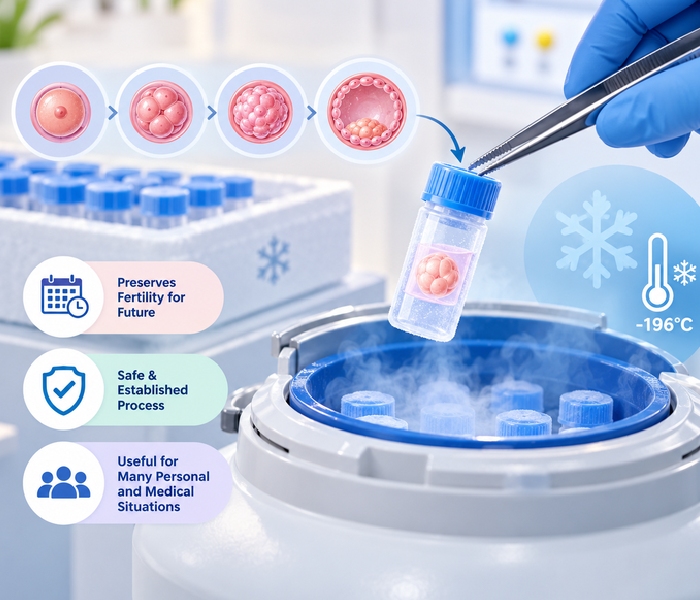
Embryo freezing lets a couple keep spare embryos from an IVF cycle and use them months or years later, without repeating stimulation or egg retrieval. It has become routine in well-equipped labs, and frozen embryo transfers now account for almost half of all IVF cycles in some countries. This guide explains what embryo cryopreservation involves, how the lab work is done, who benefits most, and what Indian law says about storage.
Key Takeaways
- → Embryo cryopreservation stores fertilised embryos at sub-zero temperature so they can be warmed and transferred in a later cycle.
- → Frozen embryo transfers made up 48 percent of all IVF cycles in the UK in 2024, up from 24 percent a decade earlier (HFEA, 2024).
- → Vitrification raised post-warming blastocyst survival from roughly 60 percent to between 78 and 100 percent in modern labs (Frontiers, 2024).
- → India’s ART (Regulation) Act 2021 allows embryos to be stored for no more than ten years, and written consent is required throughout.
- → Freezing is most often advised when a cycle leaves surplus embryos, or when treatment such as chemotherapy may damage fertility.
What Is Embryo Freezing and Why Do Clinics Recommend It?
Infertility affects about 17.5 percent of adults worldwide, roughly 1 in 6 people, according to the World Health Organization (2023). Embryo freezing, also called embryo cryopreservation, is the process of cooling fertilised embryos to very low temperature and storing them in liquid nitrogen so their development pauses.
The practical benefit is straightforward. A stimulated IVF cycle often produces more usable embryos than can safely be transferred at once. Why not transfer two or three and be finished? Because single embryo transfer is now the standard: it lowers the risk of twins without lowering your overall chance of a baby. Freezing keeps the extra embryos viable instead of discarding them, so a second attempt is far easier on the body than a fresh cycle.
Cryopreservation is also a genuine medical safeguard. People facing chemotherapy, radiotherapy or surgery that may damage the ovaries or testes can freeze embryos beforehand, which is why the European Society of Human Reproduction and Embryology treats it as an established option for fertility preservation rather than an experimental one. Our clinic’s fertility preservation service follows the same principle: protect the option before treatment begins.
How Does the Embryo Freezing Process Work?
Modern labs use vitrification, a rapid cooling method, for almost all embryo freezing. A 2024 review in Frontiers in Cell and Developmental Biology reports that vitrification lifted cryo-survival from around 60 percent with older slow freezing to 78 to 100 percent, and that nearly all vitrified blastocysts now survive warming.
The sequence runs in clear stages. Eggs and sperm are combined through standard IVF or, when sperm quality is poor, through ICSI. Embryos are cultured to day 3 or, more often, day 5 or 6 at the blastocyst stage, when selection is more reliable. The embryologist then dehydrates each embryo in cryoprotectant solutions, loads it onto a carrier device, and plunges it into liquid nitrogen within seconds.
When you’re ready to try again, the embryo is warmed, the cryoprotectant is washed out, and the embryo is assessed before transfer. Most clinics schedule the transfer around your natural cycle or a prepared hormone cycle, which takes a few weeks of monitoring and doesn’t require another retrieval. For couples where sperm quality is the limiting factor, our guide to male infertility causes and treatment options explains when ICSI is preferred.
Egg Freezing vs Embryo Freezing: What Is the Difference?
Egg freezing stores unfertilised mature eggs, while embryo freezing stores embryos that have already been fertilised and have shown they can divide. The American Society for Reproductive Medicine (2021) notes that both use the same rapid cooling technology, but the information available at freezing differs: an embryo has already proved it can fertilise and divide, while an egg’s potential isn’t known until it is warmed and fertilised. That is why embryo freezing is generally the stronger option for couples who already have a sperm source.
| Factor | Egg freezing | Embryo freezing |
|---|
| What is stored | Mature unfertilised eggs | Fertilised embryos, usually blastocysts |
| Sperm source needed | Not at the time of freezing | Yes, partner or donor sperm |
| Typical survival after warming | About 90 percent or higher in experienced labs | About 95 percent for vitrified blastocysts |
| Who it suits | Single women, or women delaying pregnancy | Couples already in an IVF cycle |
| Main limitation | Fertilisation is still unproven | Requires a committed sperm source and consent |
Who Should Consider Embryo Freezing?
Embryo freezing is usually offered to four groups of patients, and the decision depends more on your treatment plan than on age alone. The ESHRE fertility preservation guideline recommends offering it to anyone facing gonadotoxic treatment, and to couples who want to limit the number of stimulated cycles.
So who does it actually help? The first group is couples who end an IVF cycle with surplus good-quality embryos. The second is people about to start cancer treatment or surgery that threatens ovarian or testicular function. The third is couples who want preimplantation genetic testing, since freezing gives the lab time to run the test before transfer. The fourth is women who respond very strongly to stimulation, where a freeze-all approach lowers the risk of ovarian hyperstimulation syndrome.
Women with polycystic ovary syndrome often fall into that last group, because they tend to produce many eggs in one cycle. If that describes you, our article on PCOS and pregnancy explains how ovulation and stimulation are managed. Couples who don’t need IVF yet may be offered simpler treatment first: the complete guide to IUI treatment covers that pathway.
Storage Time, Lab Standards, and Consent in India
Storage length doesn’t appear to affect outcomes, but the law around it is strict. The ASRM (2021) states that the duration of storage is not associated with differences in survival or pregnancy rates, which is reassuring for anyone who froze embryos several years ago.
In India, ICMR ethical guidelines require documented consent for cryopreserving surplus embryos, correct labelling and indexing of stored material, and a clear record of what happens to embryos that are not used. The ART (Regulation) Act 2021 then caps storage of a gamete or embryo at ten years, after which it must be allowed to perish or be donated for research with the couple’s consent.
Ask your clinic four practical questions before you sign: how embryos are identified, what happens if you lose contact, what the renewal process involves, and how you can change your instructions later. A registered clinic will answer all four without hesitation, and you’re entitled to those answers in writing.
Risks, Limits, and What Happens to Unused Embryos
Freezing is reliable, but it isn’t a guarantee. Some embryos don’t survive warming, some that survive stop developing, and a transferred embryo may still not implant. That’s why cumulative success across several transfers matters more than any single result, and why clinics quote outcomes per transfer rather than per embryo stored.
One point worth separating: ovarian hyperstimulation syndrome comes from the stimulation injections, not from the freezing itself, so a freeze-all plan is a way of managing that risk rather than a cause of it. The bigger decisions, though, are often emotional rather than technical.
Couples must decide in advance whether unused embryos will be discarded, donated to another couple, or donated for research, and those instructions should be written down at the time of freezing, not years later. Counselling is part of good practice here, not an optional extra.
If you’re weighing up embryo freezing in Karimnagar or nearby, our guide to fertility specialists in Karimnagar explains what a first consultation covers and which records to bring.
Embryo freezing buys time, and time is often the factor couples cannot get back. Whether you’re preserving fertility before medical treatment or deciding what to do with surplus embryos from a cycle, a short consultation turns an abstract question into a clear plan.